Teaching Kids Common Sense: Why 30-Second Conversations Can Make a Difference
What if helping a child develop practical life skills didn’t require another lesson plan, another app, or another hour in an already busy day?
What if it started with 30 seconds?
A question at the breakfast table.
A conversation while putting away groceries.
Something noticed while walking through the house.
A simple:
“What would you do?”
We often think about teaching children in terms of giving them information. But some of the most important learning happens when we give children an opportunity to think, answer, explain and be heard.
That is where everyday conversations can become surprisingly powerful.
Common Sense Is More Than Knowing the Right Answer
Adults sometimes talk about common sense as though children should automatically have it.
But how would they?
Children are still experiencing situations for the first time.
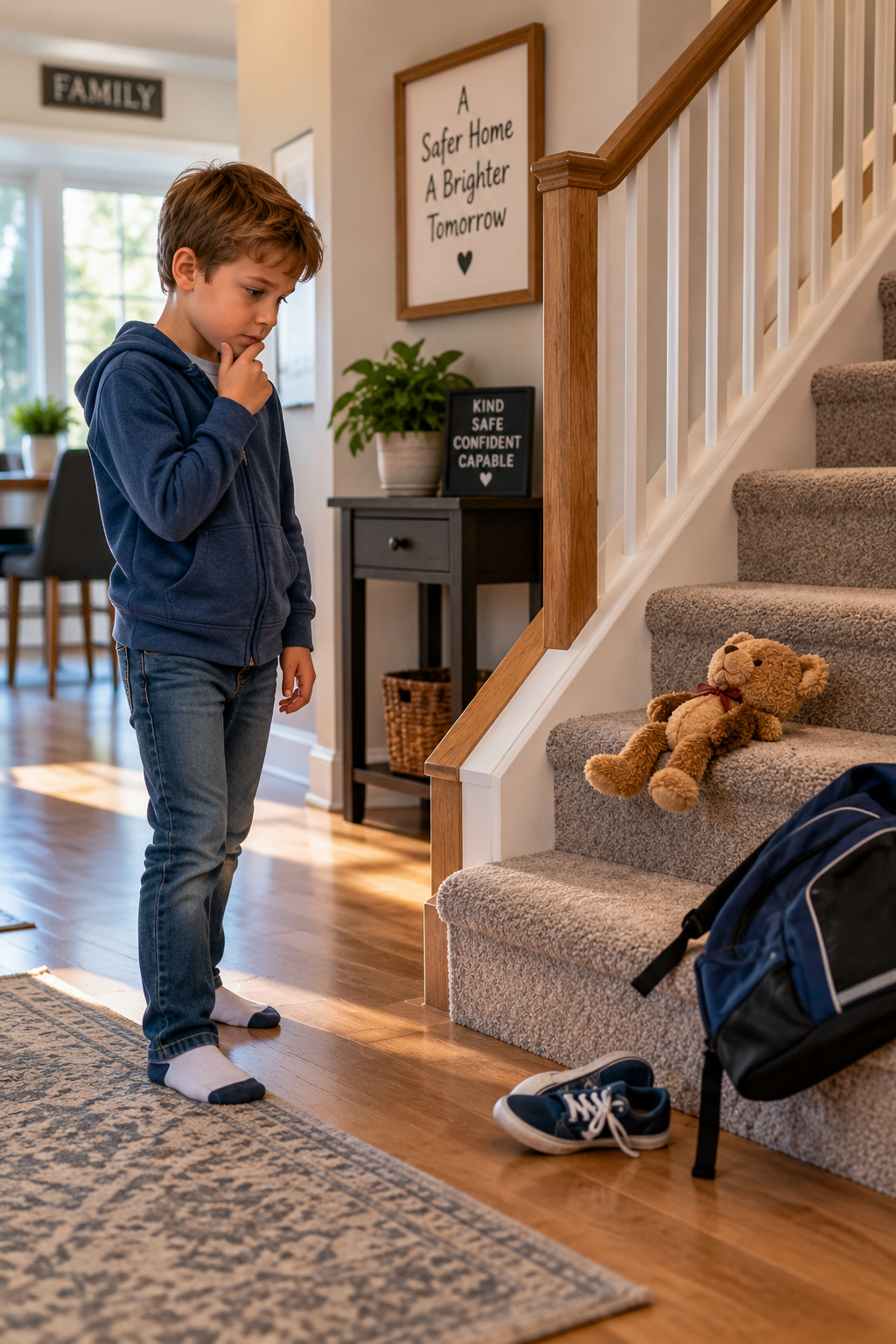
An adult may immediately recognize why leaving a toy on the stairs could be dangerous. A child may simply see the toy they were playing with five minutes ago.
We see a running tap and think about wasted water.
We see a smoke alarm and understand why it matters.
We see ten dollars and think about saving, spending and making choices.
Children are still building those connections.
Common sense isn’t simply a collection of facts. It involves noticing what is happening, thinking about possible consequences, making decisions, solving problems and learning from experience.
Those abilities develop over time.
And conversation can help.
Instead of Always Telling, Try Asking
Imagine a child leaves a backpack in the middle of the hallway.
An adult could say:
“Pick up your backpack.”
Sometimes that is exactly what needs to happen.
But there is another opportunity hiding in the same situation.
Try:
“What could happen if someone doesn’t see that backpack?”
Now the child has to think.
Someone could trip.
Grandpa could fall.
The dog could get tangled in it.
Suddenly, moving the backpack isn’t only about obeying an adult.
The child begins to understand why the decision matters.
That small distinction can turn an instruction into a learning opportunity.
The 30-Second Conversation
This doesn’t need to become a lecture.
In fact, it probably shouldn’t.
A simple conversation might sound like this:
“Can you spot the safety problem?”
The child looks around.
“The toy is on the stairs.”
Then:
“Why could that be a problem?”
The child thinks.
“Someone could trip over it.”
And finally:
“Where would be a safer place for it?”
Thirty seconds.
No worksheet.
No test.
No pressure.
But the child has just practised observation, reasoning, communication and problem-solving.
Those are practical life skills.
Their Answer May Teach You Something Too
There is another side to these conversations that adults can easily overlook.
Listen to the answer.
Not just whether it is right or wrong.
Listen to how the child arrived there.
Children sometimes notice things adults don’t. They may interpret a situation differently, ask a question you weren’t expecting, or come up with a solution you hadn’t considered.
A question as simple as:
“What would you do?”
can give a parent, grandparent, caregiver or educator a glimpse into how that child sees the world.
That matters.
When children are given appropriate opportunities to explain their thinking, the conversation becomes more than teaching.
It becomes connection.
Helping Kids Develop Common Sense Through Conversation
Seven Simple Ways to Start
You don’t need to wait for a perfect teaching moment. Everyday life provides plenty of material.
Try questions like these:
Common Sense Challenge:
“You’re leaving a room and nobody is staying in it. What could you check before you leave?”
What Would You Do?
“You found something on the floor that doesn’t belong to you. What would you do?”
Spot the Safety Problem:
“There is a toy sitting in the middle of the stairs. What could happen?”
Young Entrepreneur Challenge:
“If you wanted to earn $10 by helping someone, what safe job could you offer to do?”
Fact or Fib?
“Firefighters only help when there is a fire. Fact or fib?”
Family Mission:
“Can we find three things around the house that we could put back where they belong?”
Kindness in Action:
“Someone new joins your class and doesn’t know anyone. What could you do?”
None of these questions needs a 20-minute discussion.
Sometimes 30 seconds is enough to plant the seed.
What Happens When They Get It Wrong?
This may be one of the most important parts.
They will get things wrong.
Good.
That’s part of learning.
If every question becomes a test where the adult immediately corrects the child, children can become more focused on finding the answer the adult wants than exploring the problem themselves.
Instead, when appropriate, try another question.
“What do you think might happen if we tried that?”
Or:
“Can you think of another way?”
Obviously, safety comes first. If a child is in immediate danger, that’s not the time for a philosophical discussion about their decision-making process.
But when there is room to think safely, giving children that room can be valuable.
The objective isn’t perfection.
It’s practice.
Thirty Seconds Adds Up
One conversation probably won’t change how a child approaches every problem.
Neither will one book, one classroom lesson or one family activity.
Development happens through repetition and experience.
But imagine one short practical conversation each day.
Today it’s fire safety.
Tomorrow it’s saving money.
Then kindness.
Home awareness.
Helping a neighbour.
Looking after belongings.
Needs versus wants.
What to do when something breaks.
When to ask an adult for help.
Over time, those little conversations start connecting.
The child isn’t simply being told what to think.
They’re getting practice thinking things through.
The 30-Day Common Sense Challenge
That’s the idea behind our 30-Day Common Sense Challenge at Common Sense Factor Kids.
One small challenge.
One practical idea.
One conversation at a time.
Some will be serious.
Some will be silly.
Some might make the adults think too.
And that’s exactly the point.
Learning doesn’t have to happen only when a child is sitting at a desk.
It happens in kitchens, hallways, backyards, stores, cars and conversations.
So here’s today’s challenge:
Ask a child one question that begins with:
“What would you do if…?”
Then resist the temptation to answer it for them.
Give them a few seconds.
Listen.
You might be surprised by what you hear.
At Common Sense Factor Kids, we create books, activities and conversations designed to help children explore practical everyday knowledge alongside the adults in their lives.
Because sometimes teaching common sense doesn’t begin with giving children an answer.
It begins with giving them a question.
Everyone talks about common sense. We teach it.


